Showing posts with label India. Show all posts

Sunday, December 20, 2009

Life Cycle of a Marigold Flower


In India lemon yellow and burnt orange chains of Marigold flowers are used for everything from a welcome wreath to a religious offering.

1. A stall of Marigold chains at a local market in Delhi
2. A stand of wreaths awaits guests' arrival at a hotel in Jaipur
3. At Srinath, where the Buddha gave his first sermon after reaching enlightenment, wreaths are placed in front of statues of deities.
4. A cow in Varanasi gets a floral snack when the Marigold chains have served their purpose for the day.

Saturday, December 19, 2009

Don't Miss Deogarh


It's name means "Abode of the Gods," it was built in the 17th Century and turned into a heritage hotel in the last decade. You can walk around with an audio tour where British author William Dalrymple interviews the Rawat Nahar Singh ji II about his family's history in the place, plus you'll find one of the charming villages in Rajasthan that spreads out from the stairs of the palace and winds down the hill.

For more info www.deogarhmahal.com

Friday, December 18, 2009

Holy Rats!


Thirty miles south of Bikaner, in a tiny town called Deshnoke, you'll find what can only be described as spiritual fear factor. At the Karni Mata Temple, built by Maharaja Ganga Singh in the early 20th century, rats rule -- in their hundreds. Worshipers come to pay their respects to Karni Mata, a mystic who is considered an incarnation of Durga. When Mata's marriage dissolved, when she was 27, she devoted her life to service of the poor (it was not fun to become a widow in 15th century India). The rats (also called kabas) reside here and receive homage (and so much sugary white candies that they have developed diabetes) as their bodies are believed to house the souls of Karni Mata's departed devotees and it is believed that they will reincarnate and return as priests. My advice: Bring a pair of socks you won't be sorry to part with when it's all over.

Thursday, December 17, 2009

Sati: Does it still happen?


The practice of Sati (Satee), where a recently widowed woman jumps, supposedly willingly, onto her husband's funeral pyre and is then considered to be a deity originated around 400AD. As you tour around Rajasthan, you might notice the set hands of royal Satis on the walls of forts. Legend has it that before a woman committed Sati she dipped her hand in red paint and then made an imprint of it on the wall. (The first two pictures above where taken at the entrance to the fort in Jodhpur).

The practice of Sati is outlawed in modern India.

The Commission of Sati (Prevention) Act of 1987 Part I, Section 2(c) defines Sati as:

"The burning or burying alive of – (i) any widow along with the body of her deceased husband or any other relative or with any article, object or thing associated with the husband or such relative; or (ii) any woman along with the body of any of her relatives, irrespective of whether such burning or burying is claimed to be voluntary on the part of the widow or the women or other-wise."

However it is still socially devastating to become widowed in India and some widows can still be in their teens if they were married off young. There have been cases of Sati in certain villages in the last few decades. William Dalrymple follows one case that happened in the 1990s in a village just outside of Jaipur in his book Age of Kali. The widow was just 18.

Weirdly, these days, if you do see red hand prints at the door to a house, it may also mean that a woman there has given birth (see pic above).

Saturday, December 12, 2009

7 Things to Know about Udaipur

1. It is spelt "Oodeypore" in Rudyard Kipling's The Jungle Book and is the birthplace of Bagheera the panther.
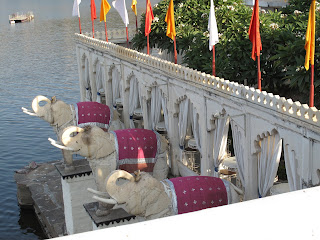
2. Indian sections of the James Bond film Octopussy were filmed in the city, the Lake Palace and the Monsoon Palace.
3. Roof terraces all over the city play reruns of Octopussy at 7pm every night. Take an auto-rickshaw down to the temples and you'll find one.
4. You might recognise the nearby desert in the dramatic scene where Bond rescues Octopussy (Maud Adams) from an aeroplane being flown by the Kamal Khan (Louis Jordan) and Gobinda (Kabir Bedi).
5. In Octopussy, Bond is sent to Delhi. The audience is never actually told that he is in Udaipur for virtually the entire movie giving the impression that Delhi is super-exotic.
6. It is a mini-Hollywood: Scenes from Darjeeling Limited, Opening Night, Heat and Dust and Gandhi were reportedly filmed there.
7. It is a mini-Bollywood too: Hindi movies have included Guide, Mera Saaya, Phool Bane Angaray, Kachche Dhagey and many more....


Photographs: Nadine Rubin
Right: The elephants that welcome you onto Jag Mandir where Octopussy ran her harem of ambidextrous babes.
Left: The Monsoon Palace which appears in Octopussy as the home of Kamal Khan


Friday, December 11, 2009

Ganesh in the House


All over India you'll find images of Lord Ganesh, the multiple-limbed elephant God who removes obstacles at the doorway to a home. We spotted him at the Karma Sutra temples in Khujarao and on the walls of houses in Jaisalmer Fort with the date of the last wedding in the family inscribed beneath his image.

Wednesday, December 9, 2009

India in Print


There's no better way to learn about the history, culture and quirks of a place than to read a mix of fiction, non-fiction and memoir.

I recommend:

1. A Princess Remembers by Gayatri Devi, especially if you'll be in Jaipur and other parts of Rajasthan.
2. Anything by William Dalrymple, but especially The Age of Kali
3. Shantaram by Gregory David Roberts. Yes it's close to 1000 pages, but the descriptions of Mumbai are unbeatable.

Tuesday, December 8, 2009

Don't Miss: Orchha


Orchha would resemble many small Indian villages in Madhya Pradesh if it weren't for the glorious medieval palaces and temple spires. According to mptourism.com, "Orchha was founded in the 16th century by the Bundela Rajput chieftain, Rudra Pratap, who chose this stretch of land along the Betwa river as an ideal site for his capital. Of the succeeding rulers, the most notable was Raja Bir Singh Ju Deo who built the exquisite Jehangir Mahal, a tiered palace crowned by graceful chhatris." Inside the palaces, along wall and ceiling are frescoes representing the Bundela school of painting. The only problem, as our guide regretfully pointed out, is that the government have no interest in restoring or protecting these treasures. Sad, when you consider that tourism is all that Orchha has going for it these days...

Monday, December 7, 2009

On Signage


Call me cheeky or even mean, but I can't help noticing funny signage or spelling errors that result in double entendres. Here are a few I spotted in India:


Sunday, December 6, 2009

Beyond Mouvember


Each year in Jaisalmer a competition is held to determine the owner of the longest mustache. You'll need more than the month of November to win this one.

Here, a regular contender and winner shows off his hirsute pride and joy.

Photograph: Nadine Rubin

Saturday, December 5, 2009

Bhang Bhang Club


Bhang (pronounced Buh-ng) is a derivative of marijuana. Is it legal in India? Nay. However, that didn't stop the owners of the Bhang Shop in Jaisalmer, India from declaring that they are "government authorized."

Photograph: Nadine Rubin

Friday, December 4, 2009

That Sinking Feeling

Imagine you are a tourist wanting to visit the Jaisalmer Fort, built in 1156 by the Bhati Rajput ruler Jaisal. This is Rajasthan's only "live-in" fort and about a quarter of the city's population still reside within the tall yellow sandstone walls. So you're paging through Lonely Planet India and...whoa!...what's this? The authors of the good book have taken a decision to not review any accommodation inside the fort itself. Instead, they ask that you, dear tourist, be eco-conscious and stay outside the fort to avoid putting additional pressure on the fort's archaic sewage system (it has been reported that three of the 99 bastions have already crumbled because of water seeping into the foundations). Residents inside the fort are allocated one hour a day within which to fill their tanks with water that needs to last them for showers, cooking and drinking. So, yes, taking two showers a day at your boutique Haveli-turned-hotel is a tad unconscious.


If you look closely at the wall in the below photograph you can see the rising water levels that are causing the fort to literally sink into the desert sand.


Photograph: Nadine Rubin

Thursday, December 3, 2009

The V.VIP Room

You'll know you've made it when you bypass the VIP Room and enter the V.VIP Room at the airport in Varanasi. We can only imagine the guest list: Maharajas, Bollywood stars and Graydon Carter.


Photograph: Paul Nathan

Tuesday, December 1, 2009

Mahatma's Message, Alive and Well


I saw this sign on the side of the road in Jaipur, Rajasthan. India is a long way from the vision that Mahatma Gandhi had for the country after independence in 1947 and sadly never saw through due to his assassination one year later. Sadly these days his message is used for commercial purposes, but hey it is still a reminder for some of us...

Photograph: Nadine Rubin

Sunday, November 29, 2009

The World's Most Beautiful Wash Line


Diana Vreeland once said, "Pink is the navy blue of India." Well, orange, red, green, turquoise are the sand, stone, beige, brown. Here, 6 meters of saris are laid out to dry on the ghats along the Ganges in Varanasi.

Photograph: Nadine Rubin

Friday, November 27, 2009

Following Buddha's Footsteps


After attaining enlightenment at Bodh Gaya the Buddha travelled to Sarnath to preach his first discourse in the deer park. His discourse is said to have set in motion the 'Wheel of the Dharma'. Visit peaceful Sarnath when you visit Varanasi. The site is about 20 minutes away and it offers a wonderful reprieve from the madness of Varanasi.

Photograph: Nadine Rubin

Monday, July 23, 2007

Above the fold

I call my friend Dan Levin my 26-year-old mentor because his attitude reminds me to be fearless in my own pursuits. In just one year of writing Dan has been published over thirteen times in various sections of the New York Times. Dan had a story published on the front page of the International Herald Tribune today. Hurrah! It's a wonderful tale of how a microfranchising business that gets spectacles to the poor has brought myopic Indians back from the brink of dire poverty just by enabling them to see better so that they can resume their work.

Here's the PDF of the front page: http://iht.com/pdfs/frontpagepdf/asiafrontpage.pdf


And here's the link to the piece: http://iht.com/articles/2007/07/23/business/scojo.php